
15 May 2026
AMSOIL Metric 10W-50 — Why 4.9 cP HTHS Is the Correct Number for KTM, Husqvarna and Ducati
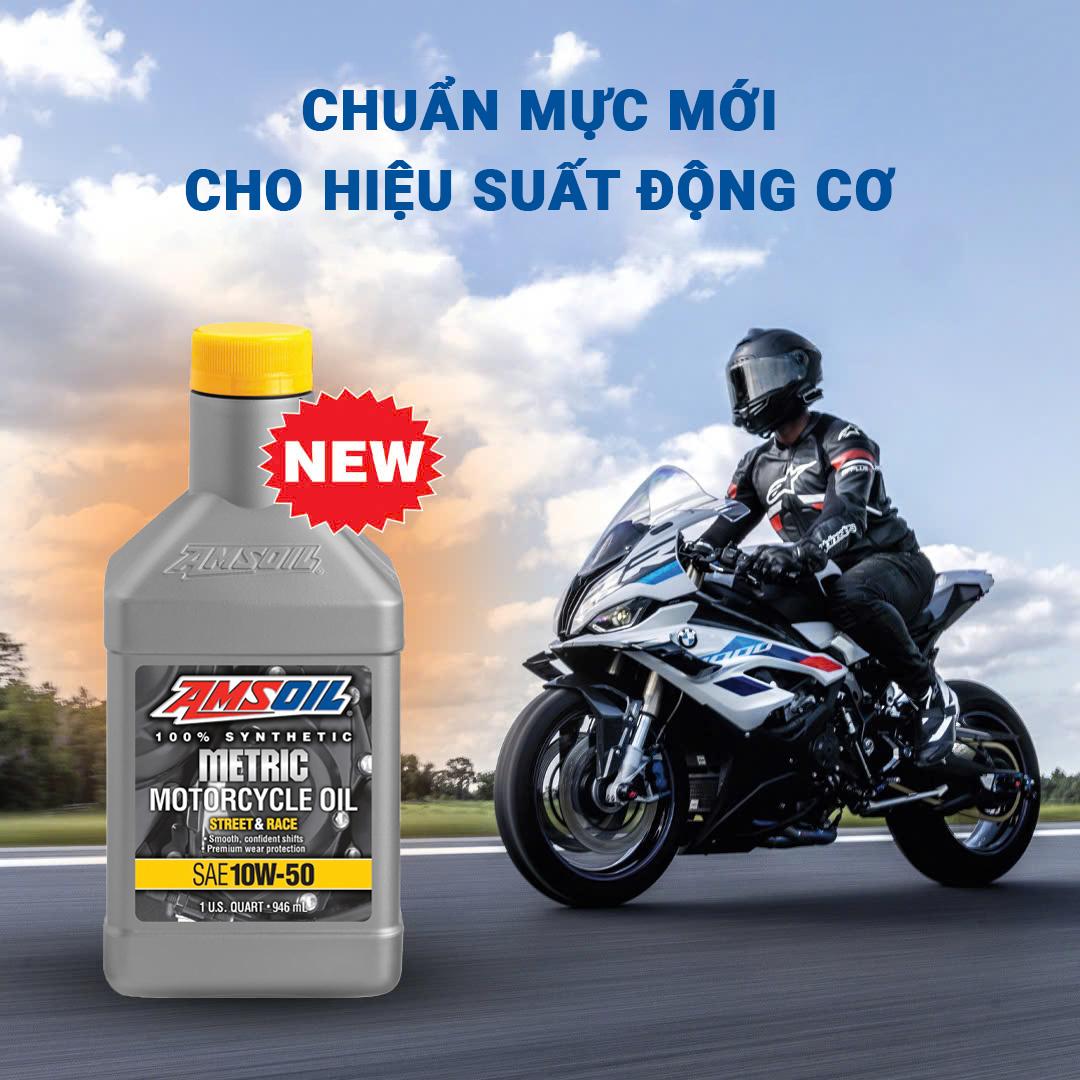
KTM Duke 790 and Husqvarna Vitpilen owners still regularly get handed 10W-40 at service shops — "standard for all manual bikes," the technician says. On a Wave or a Sirius, that is fine. On the LC8c or the Husqvarna singles, 10W-40 is not technically wrong — it just ignores a parameter the engineers built into the engine thermal tolerances from the start: HTHS viscosity.
The issue is not that 10W-40 fails. It is that High-Temperature High-Shear viscosity — measured at 150°C under 10⁶ s⁻¹ shear — is what actually describes oil film thickness at the piston ring–cylinder wall interface and main bearings under high-RPM load. That is the condition SAE grade alone does not fully capture.
AMSOIL Metric 10W-50 (MSR) — 4.9 cP HTHS, 4.7% Noack volatility, 236°C flash point — is not a "heavier oil for safety margin." It is a product engineered to meet the precise spec of high-output engines from KTM, Husqvarna, Ducati and Triumph: powerplants optimized for maximum specific output in the smallest possible displacement.
1. HTHS — The Overlooked Number in Motorcycle Oil Selection
Most riders compare SAE grade and API/JASO certification. That is a reasonable starting point but leaves out the metric that actually determines real-world protection: HTHS viscosity, measured at 150°C and 10⁶ s⁻¹ shear rate — conditions that simulate the piston ring–cylinder wall contact zone and main journal bearings at high RPM.
To put the numbers in context:
- JASO MA2 minimum requirement: HTHS ≥ 2.9 cP
- AMSOIL Metric 10W-40 (MCF): approximately 3.8 cP HTHS
- AMSOIL Metric 10W-50 (MSR): 4.9 cP HTHS — 29% thicker film than 10W-40 under identical operating conditions
- That 1.1 cP gap is not theoretical — it is the actual protective film thickness at the contact surfaces when the LC8c is at 8,500 rpm and 38°C ambient
1.1. Why KTM and Husqvarna Specify 10W-50
KTM and Husqvarna (both under KTM AG) optimize for maximum power-to-weight ratio. The LC8c 789cc parallel twin produces 105 HP — 133 HP/liter, on par with serious European sports cars. Small engine, high RPM, higher cylinder head temperatures than larger-displacement engines producing equivalent power.
The KTM 1290 Super Duke R V-twin puts out 177 HP from 1,301cc with even less oil volume available for thermal management. In Southeast Asian markets, KTM specifies 10W-50 for tropical conditions not because 10W-40 fails outright — but because the HTHS protective margin at actual operating temperatures becomes uncomfortably thin at sustained 38°C ambient.
1.2. Ducati and Triumph — Same Reasoning, Different Architecture
Ducati L-twins (Monster 950/1200, Scrambler 1100, Hypermotard 950) officially recommend 10W-50 or 15W-50 for most models. The 90° L-twin configuration maximizes cylinder cooling airflow but still generates high operating temperatures at the piston interface — the direct driver of needing higher HTHS.
Triumph Speed Triple 1200 RS lists 10W-40 as minimum with an explicit footnote: 10W-50 or 15W-50 for high temperatures and sustained heavy loads. In Vietnamese conditions, "heavy loads" can simply mean a continuous 200 km tour in full sun or sustained highway riding at 100 km/h — no circuit required.
2. MSR Specifications — What Each Number Actually Means
Rather than general commentary, here are the actual MSR specifications and what each means in real operating conditions:
- Kinematic viscosity @ 100°C: 18.5 cSt — at engine operating temperature, MSR maintains significantly thicker film than 10W-40 typical 13–14 cSt
- HTHS @ 150°C: 4.9 cP — 69% above JASO MA2 minimum (2.9 cP); actual protective film at main bearings and rings under high-RPM load
- Viscosity Index: 167 — enables easy cold starts (pour point -36°C) while maintaining adequate film at operating temperature — not a tradeoff between cold and hot performance
- Noack Volatility: 4.7% — exceptional for a 10W-50, meaning the oil neither thins significantly nor depletes unusually fast over the drain interval
- Flash point: 236°C — above any realistic operating temperature, including circuit conditions in tropical climates
- TBN: 11.6 — acid neutralization capacity above most competing 10W-50 products, extending protection between drain intervals
3. JASO MA2 and the Gearbox Case for Performance Bikes
JASO MA2 is not only about clutch friction coefficient — it also addresses oil film stability at the high shear rates inside a transmission under race-pace shifting. High-performance manual bikes like the KTM RC390, Yamaha R7, and Kawasaki Z900 operate at RPM levels significantly higher than commuter bikes — the 6-speed gearbox absorbs sudden load changes from rapid shifts at 8,000+ rpm.
MSR combination of JASO MA2 certification and 4.9 cP HTHS delivers both: consistent clutch engagement and adequate gearbox protection through aggressive shifting. Lower-spec 10W-50 products with minimal HTHS and lower TBN produce a thinner protective film and lose performance faster under sustained tropical heat.
Conclusion
MSR is the right choice when your engine service documentation specifies 10W-50 — or when operating conditions demand HTHS ≥ 4.5 cP to maintain adequate protection margins in Vietnam climate. For KTM, Husqvarna, Ducati, and Triumph, that is not optional. Contact Huynh Chau at daunhothuynhchau.com or hotline 090 831 5193 — 0907 579 300 to confirm the correct spec for your specific model.
Huynh Chau Oil Importer & Distributor